
BrightMind / Workforce ARC
Reading mode
How to Make Learning Stick with Catalytic Curriculum Design
Most training delivers information, but very little creates understanding that lasts. This article is the first in a series that explores how to make learning stick by explaining why durable understanding is rare and by introducing catalytic curriculum design, a framework that lowers the barriers to insight. It sets the stage for a series that will unpack the methods and strategies behind meaningful, long-lasting learning.

December 10, 2025
6 min read
Information Is Everywhere, Understanding Is Rare
In my experience, understanding emerges more reliably when learners are prepared for insight, not just exposed to information. In education and training, we sometimes overlook this, placing our attention on content instead of the overall environment that allows a new idea to take hold.
Catalytic curriculum design offers a different perspective on how to make learning “stick.” It treats learning as a living system, where preparation, sequencing, and the easing of cognitive bottlenecks determine whether a concept becomes durable knowledge or dissolves into confusion. This approach originated with BrightMind eLearning and continues through the Workforce Applied Research Center, which carries this work forward in the public interest. Together we operate on the belief that durable understanding is possible for everyone when we design pathways that lower the barriers to insight.
What Is Catalytic Design for Workforce Development?
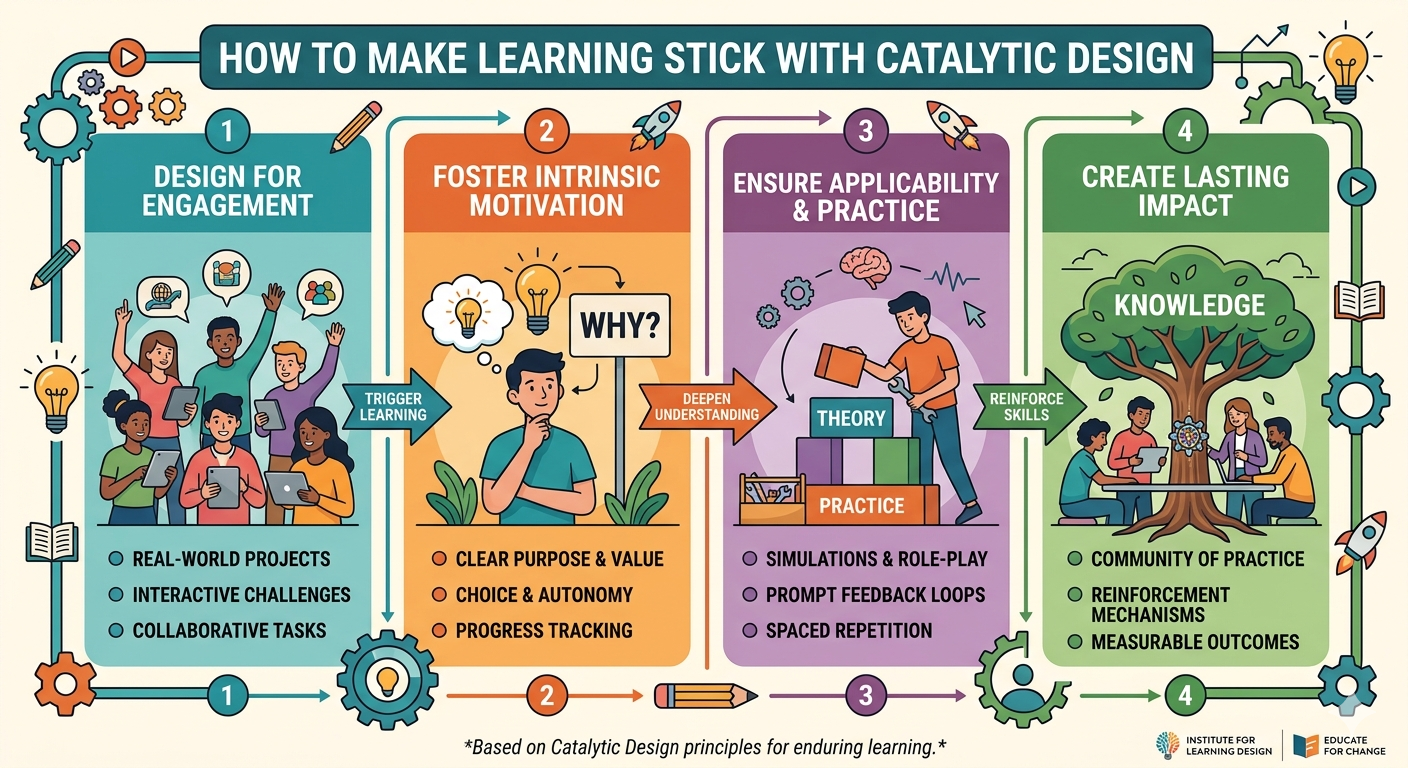
Catalytic curriculum design is an instructional approach that prepares the learner’s mind for insight by structuring context, pacing, and conceptual flow so learners reach understanding with less cognitive friction. Instructional techniques that make catalytic design work include scaffolding, chunking, progressive abstraction, cognitive bottleneck mapping, and the sequencing methods that make insight more likely. The learner experiences clarity because the curriculum creates space for that clarity to occur. This approach reflects years of applied work across diverse learning settings. Over this time, one pattern appeared again and again. Insight becomes more reliable when learning is treated as a process rather than a sequence.
Why This Matters
Learning is often treated as a matter of delivering information, yet most people forget what they hear long before they can use it. Catalytic curriculum design shifts the focus toward creating conditions that make understanding more likely, more durable, and more accessible to every learner. This matters because the ability to grasp and apply new skills is one of the strongest drivers of opportunity, mobility, and confidence. When we design learning intentionally for long-term skill retention, insight becomes something we can cultivate rather than hope for.
Introducing the Catalytic Design Series
This article is the first in a series exploring how instructional design can intentionally create the conditions that lead to *epiphanies*, those “ah-ha” moments when understanding snaps into place and a learner sees the world differently than they did a moment before. These insights are not happy accidents, or at least, they don’t have to be. They can and should be engineered to emerge when ideas are framed, sequenced, and supported in ways that help the mind reorganize what it already knows and integrate what is new. This is an important aspect of how knowledge can lead to competence and understanding can be catalyzed into skill.
What This Series Will Explore
This series will unpack the core components of catalytic curriculum design one idea at a time. We’ll look at how catalytic curriculum design lowers the activation threshold for these moments and how deliberate choices in structure, pacing, and context can make learning feel both intuitive and transformative.
Future articles will explore how catalysts work as metaphors for learning, why a prepared mind is more important than content exposure, and how scaffolding and chunking act as structural supports for insight leading to a durable understanding of the subject matter. We will look at cognitive orchestration as a design discipline, examine the nature of engineered epiphanies, and show how durable instruction helps understanding hold its shape long after the lesson ends. Together, these pieces form a comprehensive view of how learning can be intentionally designed for transformation rather than memorization.
Conclusion
Catalytic curriculum design invites us to rethink what instruction is for. When learning becomes easier to grasp and harder to forget, learners gain the confidence and competence needed to move forward in their work and their lives. This introduction is the first step toward a more deliberate, insight-rich approach to education. The articles ahead will explore each component in greater depth, offering practical guidance for designers who want learning to do more than inform, but to transform.
I’ve come to realize that there will always be elements of learning that we as curriculum designers will be unable to fully control. Even so, we can shape the conditions that make insight more likely. As Louis Pasteur observed, “chance favors the prepared mind.” When we make the effort to prepare learners as best we can, understanding becomes far more than a fortunate accident.
The practical takeaway
Effective learning systems should help people apply knowledge in real contexts, make better decisions, and demonstrate measurable capability over time.
Continue the conversation
Explore related ideas and continue through the Workforce ARC insights series.
About the Author
Patrick Finnegan writes about instructional design, workforce readiness, and capability-based training systems.