
What Are Catalysts for Learning?
A catalyst for learning is something that lowers the barrier to a new connection forming between new and existing knowledge, without adding to what needs to be learned.
Picture a high school chemistry classroom. A single flask holds acetic acid, its sharp vinegar smell already filling the air. The teacher pours in a second liquid, isoamyl alcohol, clear and faintly oily, and swirls the flask. Nothing happens. No new smell, no visible change, nothing to suggest the two are on their way to becoming anything else.
The teacher leaves the flask on the counter overnight. By the next morning, it looks and smells exactly as it did the day before. Whatever these two liquids were capable of becoming, time alone hasn’t gotten them there.
The next day, the teacher sets the flask on a warming plate and adds a few drops of sulfuric acid. None of the students knew what to expect. But within half an hour, the vinegar smell is gone, and the whole classroom smells like ripe banana.
Nothing about the original ingredients changed. The acetic acid is still acetic acid. The isoamyl alcohol is still isoamyl alcohol. With the help of the catalyst, sulfuric acid, they combine to create isoamyl acetate, the compound behind that banana smell. What changed is the pathway between them. The catalyst lowered the energy the reaction needed to get started. It didn’t add a new ingredient to the outcome. Instead, it changed how easily the ingredients already in the flask found each other.
The chart below illustrates the results. Without a catalyst, even the hottest condition shown still takes over a day to reach meaningful conversion. With the catalyst, that same range of temperatures cuts the time to minutes. The pattern holds at every temperature: the catalyst doesn’t just nudge the result, it changes the timescale entirely.
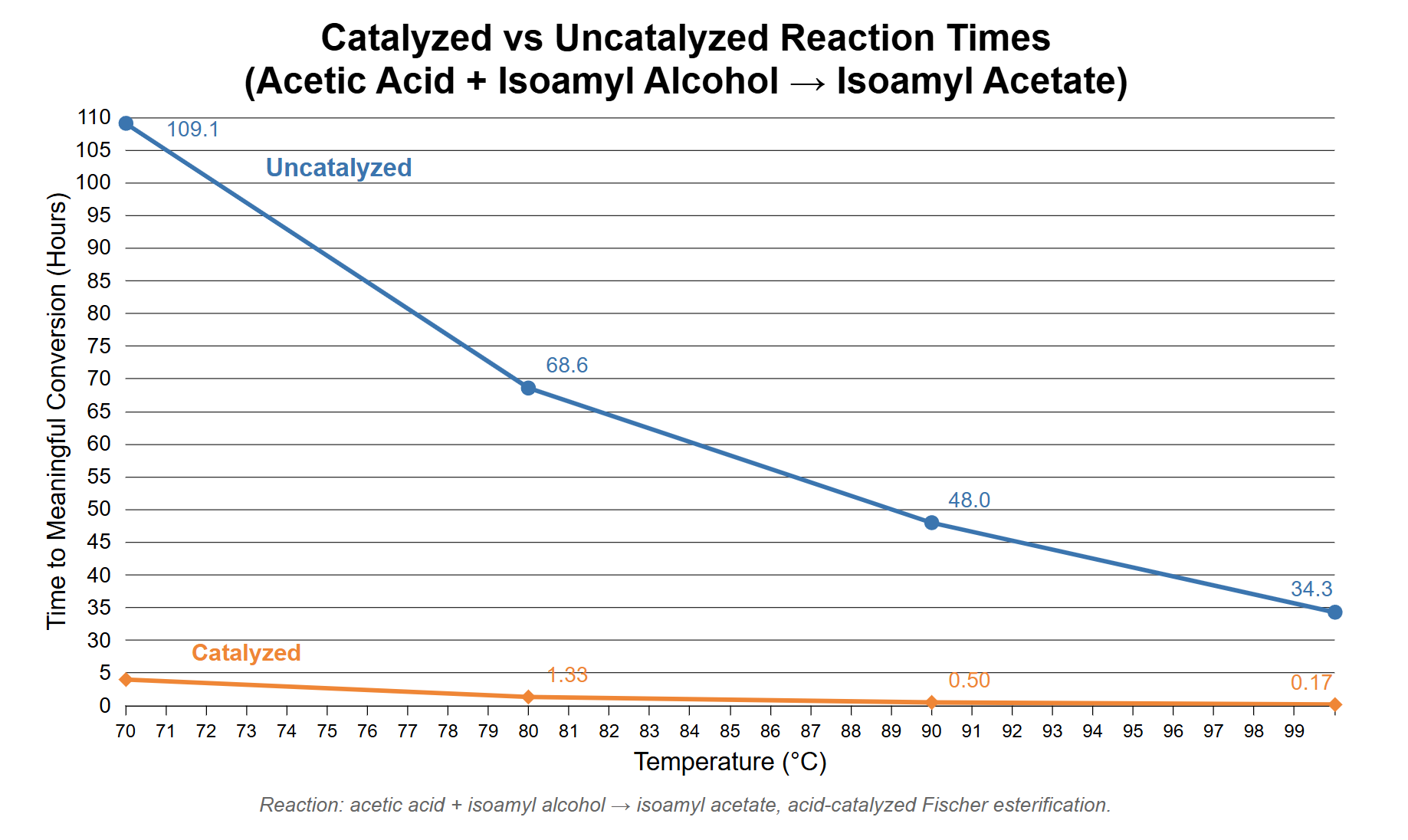
That’s the catalyst’s whole contribution: not a new outcome, just a shorter route to the one already possible.
01
DEFINITION
Defining a Catalyst for Learning
I keep thinking about this demonstration because learning seems to work on the same principle. A learner can be given one fact, then handed a second, and simply placing them side by side does little to create a broader understanding. It just creates two isolated facts in the same “container.” Often, what’s needed isn’t a third fact poured into the mix. It’s some form of catalyst that will allow the new and existing knowledge to more easily combine into something new, useful, and durable.
In this metaphor, heat is the effort a learner brings like time, attention, and persistence. A learning catalyst is the change in methodology a designer brings: techniques like sequencing, framing, and timing. Neither replaces the other. Effort alone has an upper limit with diminishing returns. A methodology change alone has nothing to act on if a learner brings little effort to it. The results worth having, fast and deep, come from the two working together.
So then, the goal isn’t learning without effort. It’s more learning from the effort learners are already able to provide.
So what actually counts as a catalyst for learning? It’s anything that lowers the barrier between what a learner already knows and what they’re about to encounter, without adding to what needs to be learned. It doesn’t teach the material. It changes the conditions that make the material learnable: the sequence something is presented in, the timing of when it arrives, the framing that surrounds it.
Consider a study Manu Kapur ran with two groups of students learning the same concept in statistics: variance. One group received instruction first, then practiced. The other group got the problem first, an unfamiliar scenario to work through with no instruction at all, before receiving the same instruction the first group started with.
Kapur calls this productive failure. The idea is that failure isn’t wasted effort, it’s preparation. The struggle itself does the work of a learning catalyst, activating whatever related knowledge a learner already has and creates a specific readiness for the instruction that follows.
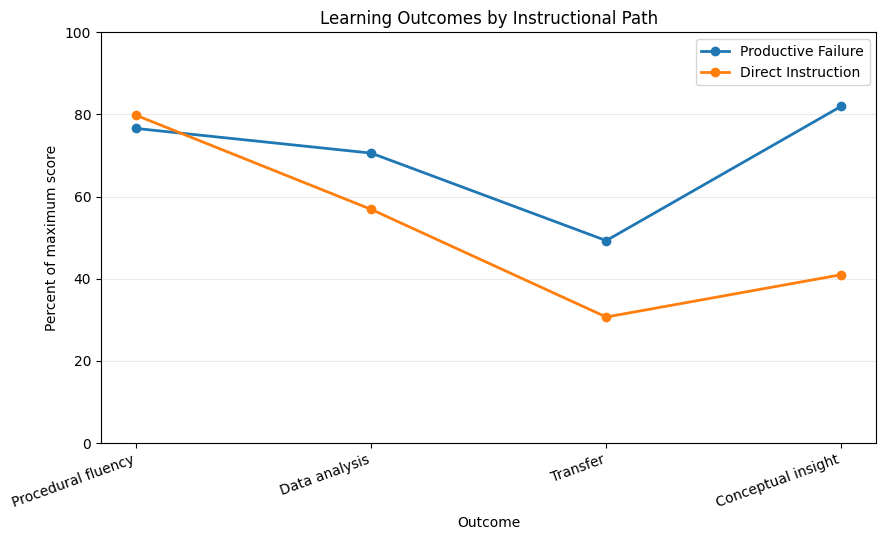
The chart above shows both groups performed about the same on procedural fluency – memorizing and recalling the steps involved. But their results showed real improvement in outcomes that asked students to analyze, transfer, or understand what they’d learned, exactly where productive failure’s advantage shows up.
Kapur’s finding is not an isolated result. His study tested one specific technique, productive failure, but the underlying principle, that students benefit from working with material themselves rather than only receiving it, holds up much more broadly. A 2014 meta-analysis in the Proceedings of the National Academy of Sciences (PNAS) examined 225 studies comparing traditional lecturing to another catalytic technique, active learning, across every major STEM discipline. Passing rates were 66.2% under traditional lecturing versus 78.2% under active learning, an 18% increase in the likelihood of passing when students were required to work with the material themselves rather than only told (Freeman et al., 2014).
Neither Kapur nor Freeman use the word catalyst. But together, their results describe exactly what one does: it adds nothing to what needs to be learned, it changes the conditions under which learning happens, and its effect is strongest exactly where understanding, not just repetition, is required.
02
COMPONENTS
Six Components, One Reaction
Catalytic curriculum design rests on six components. Each addresses a different piece of how insight actually forms and lasts.
Six components. One underlying premise: understanding isn’t something we hand a learner. It’s a reaction we design the conditions for.
03
KEY TERMS
Key Terms Discussed in This Article
Catalyst for Learning
A learning catalyst is anything that lowers the barrier to a new connection forming between what a learner already knows and what they’re about to encounter, without becoming part of what needs to be learned. It doesn’t replace the effort a learner brings, it changes the conditions, the sequence, the timing, the framing, under which that effort is far more likely to produce understanding.
Catalytic Curriculum Design
The deliberate preparation and orchestration of the conditions in which a particular insight is more likely to form.

REFERENCES
Sources Cited in This Article
Kapur, M. (2012). Productive failure in learning the concept of variance. Instructional Science, 40(4), 651-672. https://doi.org/10.1007/s11251-012-9209-6
Freeman, S., Eddy, S. L., McDonough, M., Smith, M. K., Okoroafor, N., Jordt, H., & Wenderoth, M. P. (2014). Active learning increases student performance in science, engineering, and mathematics. Proceedings of the National Academy of Sciences, 111(23), 8410-8415. https://doi.org/10.1073/pnas.1319030111
In this post