
I didn’t start Workforce ARC with a finished model in my head.
I started with a frustration that kept coming back.
For decades, I’ve worked around training, onboarding, instructional design, and workforce preparation. In that work, I kept seeing a pattern that was common enough to feel normal, but important enough that I couldn’t leave it alone.
An organization needed training. The need was real. The deadline was real. The budget had limits. People were waiting for something useful, and the responsible thing often seemed to be getting a first version into production.
So we built a “minimum viable product” version.
There’s nothing wrong with that in itself. In many ways, it reflects how we work at BrightMind eLearning and Workforce ARC. Iterative development is responsible development. A first version can expose assumptions, reveal learner friction, and create the evidence needed to improve the system.
But a “first version” is only a first version if there’s a second version. In other words, iterative design only works if improvement cycles actually follow.
Key Insight
A first version is not the problem. The problem is when a first version becomes the working version without a protected path for improvement.
Too often, they didn’t.
When the First Version Becomes the Working Version
The plan usually made sense at the beginning.
Launch the basic version. Watch what happens. Gather feedback. Improve the design. Strengthen the practice. Revisit the measurement. Make the next version better.
Sometimes that happened. When it did, the first version served its purpose. It gave us something to learn from, and the learning system became stronger because of it.
But more often than I expected, the next urgent project arrived before the previous one had matured. The feedback was there, but it wasn’t fully addressed. The thin practice layer stayed thin. Known gaps stayed where they were. The course had launched, the box had been checked, and then, seemingly within minutes, attention had already begun moving down the backlog.
I guess that’s natural. It’s what busy systems tend to do.
Backlog pressure is real. New employees need onboarding. Policies change. Software changes. Compliance dates arrive. Different departments need support at the same time. Leaders want movement, and managers need something they can point to.
In that kind of environment, improvement work can start to feel secondary, even when it’s the very work that would make the system more useful.
Eliyahu Goldratt’s The Goal and the Theory of Constraints helped many of us see that a system does not improve just because every part is busy. Improvement depends on understanding the constraint and organizing work around it.
I began to see a similar problem in learning systems. We could keep launching new training, but if the real constraint was weak feedback, thin practice, unclear readiness standards, or no protected time for revision, then more launch activity would not solve the problem. A systematic approach was needed, not because people lacked effort, but because effort was being absorbed by the system faster than the system was improving.
Decision Rule
If the constraint is weak feedback, thin practice, unclear readiness standards, or no protected time for revision, launching more training will not solve the underlying problem.
There’s another issue too. Many organizations have never seen what mature learning measurement looks like. If completion rates look acceptable, satisfaction scores are decent, and the launch happened on time, the early signals can make the work appear more complete than it is.
The training exists. People are taking it. The dashboard isn’t empty anymore. The exposed need feels less exposed, and that feeling of relief is understandable. But pressure relief is not the same thing as readiness.
Common Mistake
Interpreting system relief as learner readiness. A course can reduce pressure, satisfy stakeholders, and fill a dashboard while still leaving the readiness question unanswered.
The Problem Beneath the Pattern
This is where the issue became harder for me to ignore.
A system could show that training happened without showing that readiness formed.
That sentence captures much of the reason Workforce ARC exists.
Completion can tell us someone reached the end of an experience. It can’t, by itself, tell us whether the person can use what was taught.
A credential can tell us something about exposure, effort, persistence, or achievement. It doesn’t automatically tell us whether someone is ready for the actual demands of a role.
A quiz score may tell us something about recognition or recall. It may not tell us whether a person can make a sound decision when conditions change.
These signals matter. I’m not interested in dismissing them. The problem comes when we treat them as stronger evidence than they really are. Signals can prompt better questions, but they can’t answer every question they raise.
Key Insight
Signals are useful because they tell us where to look. Evidence is necessary because it tells us what we can responsibly claim.
The Question That Would Not Let Go
The question I kept returning to was simple:
Not generally ready. That phrase is too vague to help much.
Ready for what? Under what conditions? To what standard? With what level of support? Facing what level of pressure, ambiguity, or consequence?
Key Insight
Readiness is not a general condition. It has to be defined in relation to specific work, conditions, standards, and levels of support.
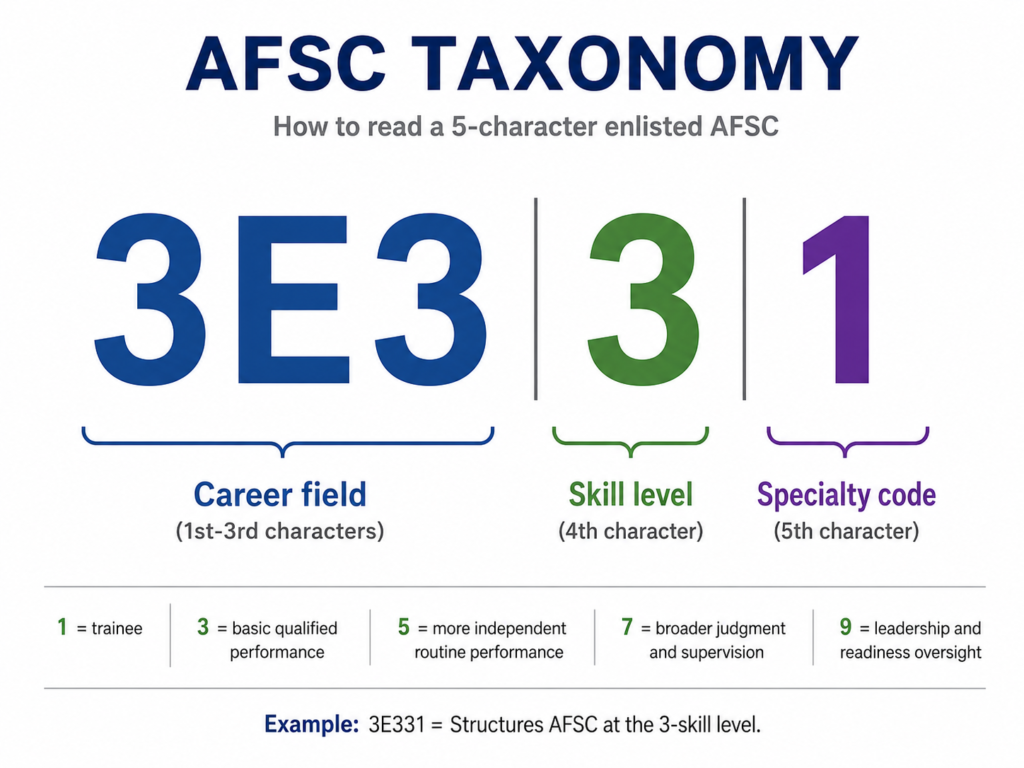
Part of my sensitivity to that question probably comes from my Air Force experience. In the military, readiness was not treated as a single flat label. There were structures for thinking about training, evaluation, progression, responsibility, and trust. The point was not merely that someone belonged to a field. The point was whether that person had been prepared, evaluated, and trusted with a given level of responsibility inside that field.
That idea stayed with me.
Many civilian systems have similar tools available: job families, role levels, competency models, learning paths, skill taxonomies, proficiency indicators, and Learning Management System data. The structures often exist. The harder question is whether we use them carefully enough to define readiness, guide training, evaluate progress, and support honest progression.
That is where I think we have work to do.
Why Workforce ARC
Workforce ARC exists because readiness is too important to leave implied, assumed, or inferred from weak signals.
COMMON MISCONCEPTION
The argument is not that completion, credentials, quiz scores, or satisfaction data are useless. The argument is that they become misleading when we ask them to prove more than they can actually show
Too many systems show activity without showing readiness. Too many programs report completion without knowing whether capability has formed.
Too many organizations are working with signals when what they need is evidence.
I don’t say that as an accusation. Most people in education, training, and workforce development are working inside real constraints. Many are doing serious work with limited time, limited budget, and competing demands.
But effort alone does not fix an alignment problem.
If the system rewards delivery, we will keep delivering.
If it rewards the next launch more than the previous improvement cycle, we will keep mistaking motion for progress.
Workforce ARC is an attempt to ask a more disciplined question:
Are we helping people become ready for real work, and how would we know?
Decision Rule
If we claim readiness, we need evidence that can bear the weight of that claim. Activity can support the story, but it cannot carry the conclusion by itself.
That question is not small. It touches training, assessment, onboarding, employer trust, learner support, workforce development, and national capacity.
It also requires humility. Workforce ARC does not begin with the claim that we already have the full answer. The work itself will need to be tested, corrected, strengthened, and improved.
That is part of the method.
A Public-Benefit Work
Workforce ARC is being built around a public-benefit conviction: workforce readiness is infrastructure.
Key Insight
Workforce readiness is not only a training issue. It is part of the infrastructure that connects learners, employers, communities, and national capacity.
It is not only an internal training issue, and it is not only an employer concern. Readiness shapes whether people can enter meaningful work, whether employers can trust preparation, whether communities can strengthen their economies, and whether the country can build the capability it needs for the future.
When readiness is poorly defined, the costs do not stay neatly inside a course or a department. Learners carry the cost when preparation does not hold up. Managers carry it when they have to compensate for gaps the system did not address. Employers carry it through slower time-to-capability, rework, supervision burden, and missed opportunity. Communities carry it when local workforce systems cannot reliably help people move into stable, productive work.
That is why this work has to be more than another training discussion.
The goal is not to add more noise to a field already full of frameworks, platforms, dashboards, credentials, and initiatives. The goal is to help bring more discipline to a question many people already care about:
Are we helping people become ready for real work, and how would we know?
That question requires common purpose because no single group owns the whole answer.
Learners know where preparation feels clear and where it breaks down. Instructors know where explanation stops and performance begins. Instructional designers know the tradeoffs between time, budget, scope, practice, and support. Employers and managers know where preparation holds under real conditions and where it fails. Researchers, administrators, workforce leaders, and policymakers see the larger systems that shape what is possible.
Those perspectives are not interchangeable. They are complementary.
If Workforce ARC is going to serve the public good, it has to learn from the people closest to different parts of the readiness problem while still doing the disciplined work of definition, testing, evidence, and improvement.
That is the common purpose I hope Workforce ARC can help build: not agreement around a slogan, but shared work toward more trustworthy readiness.
Together, we can become more honest about what our signals do and do not prove. We can use existing systems more wisely. We can protect time for improvement instead of letting every first version become the working version. We can look for ways to improve both efficiency and efficacy, because efficiency is how we will pay for excellence, and efficacy is how we know whether that excellence is real.
Workforce ARC will not treat readiness as something to be assumed from activity. We will treat it as something to be defined, developed, evaluated, and improved.
Workforce ARC will not treat readiness as something to be assumed from activity. We will treat it as something to be defined, developed, evaluated, and improved.
That is the work I am stepping into, because the question, “what is readiness,” is too important to leave partially answered.