
BrightMind / Workforce ARC
Reading mode
Workforce Readiness Lags Despite High Education Levels
Credentials, Risk, and the Cost of Delay Despite record levels of educational attainment, workforce readiness remains stubbornly slow. Employers routinely hire credentialed candidates only to discover that meaningful contribution still requires months – sometimes years – of additional training, supervision, and adjustment. Job-seekers invest increasing amounts of time and money in degrees and certificates that…

December 30, 2025
6 min read

Credentials, Risk, and the Cost of Delay
Despite record levels of educational attainment, workforce readiness remains stubbornly slow. Employers routinely hire credentialed candidates only to discover that meaningful contribution still requires months – sometimes years – of additional training, supervision, and adjustment. Job-seekers invest increasing amounts of time and money in degrees and certificates that promise opportunity, yet often deliver delay. Workforce agencies and policymakers continue to fund education and reskilling initiatives, even as employers report persistent readiness gaps.
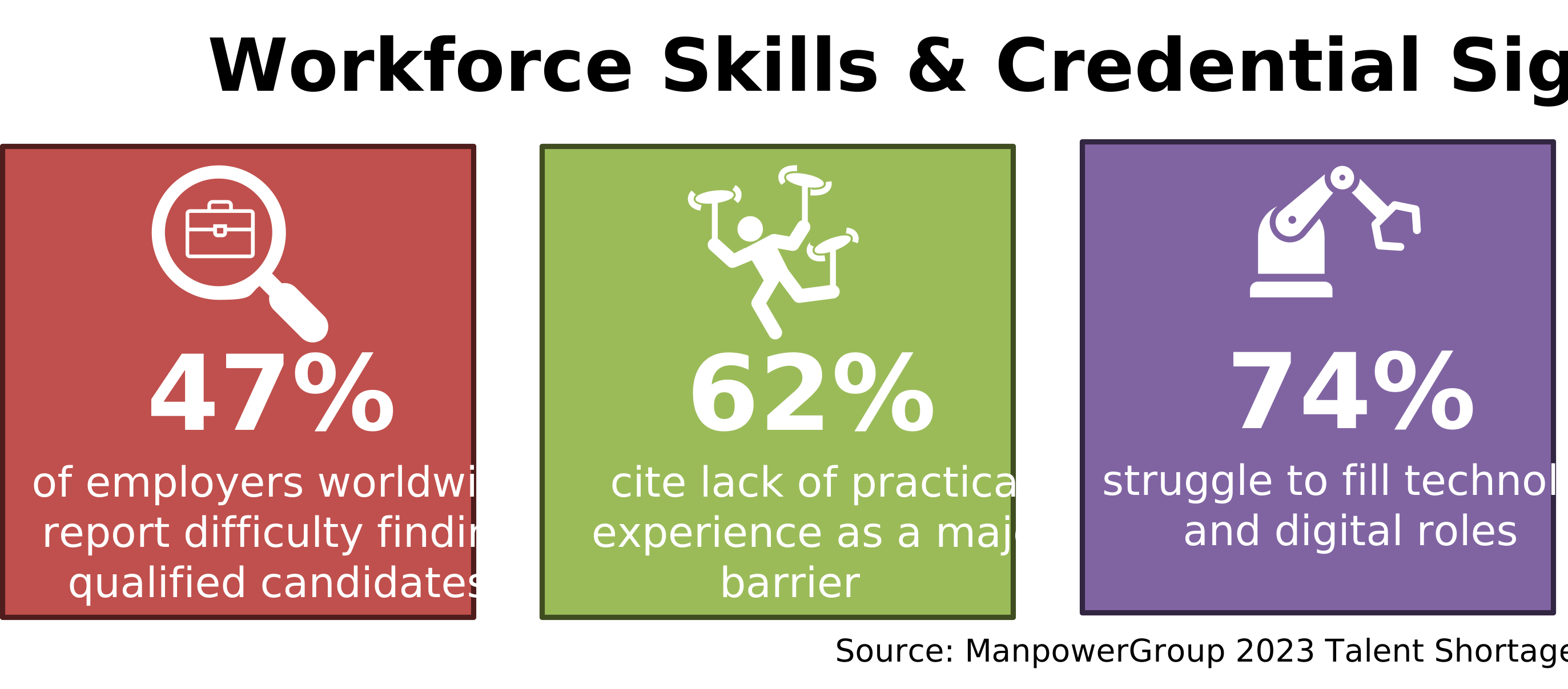
Nearly 50 % of employers worldwide report difficulty finding candidates with the right skills to fill open positions. Over 60% cite a lack of practical experience as a key factor in the skills gap and about 75 % of employers struggle to fill technology and digital roles due to a lack of qualified applicants.
This disconnect is widely felt but rarely examined directly. When readiness lags, the explanation is usually individualized – this hire needs more time, that program needs refinement – rather than systemic. The assumption remains that credentials, while imperfect, are the best available proxies for employability and preparedness.
Yet consider one concrete indicator of the mismatch: surveys of large employers routinely report that new hires, including those with relevant degrees, require six months or more to reach expected productivity. Whatever credentials are signaling, they are not reliably shortening that window.
The issue is not effort, intelligence, or good faith. It is a problem of system design.
Credential Use as a Hiring Filter
Credentials persist because they are efficient for the institutions that use them.
For employers and workforce agencies, credentials function as easy-to-apply and low-cost risk filters. They are standardized, widely recognized, and easy to apply at scale. A degree or certificate allows organizations to reduce large applicant pools quickly, consistently, and defensibly. In regulated or high-liability environments, credentials also provide procedural cover: decisions can be justified by reference to established norms rather than individual judgment.
From the institutional side, this is rational behavior. Employers face real constraints – time, compliance, internal capacity, and legal exposure. Workforce agencies must process high volumes of participants using criteria that are legible and auditable. In that context, credentials are attractive not because they are precise, but because they are inexpensive to use.
The cost, however, does not disappear. It is shifted.
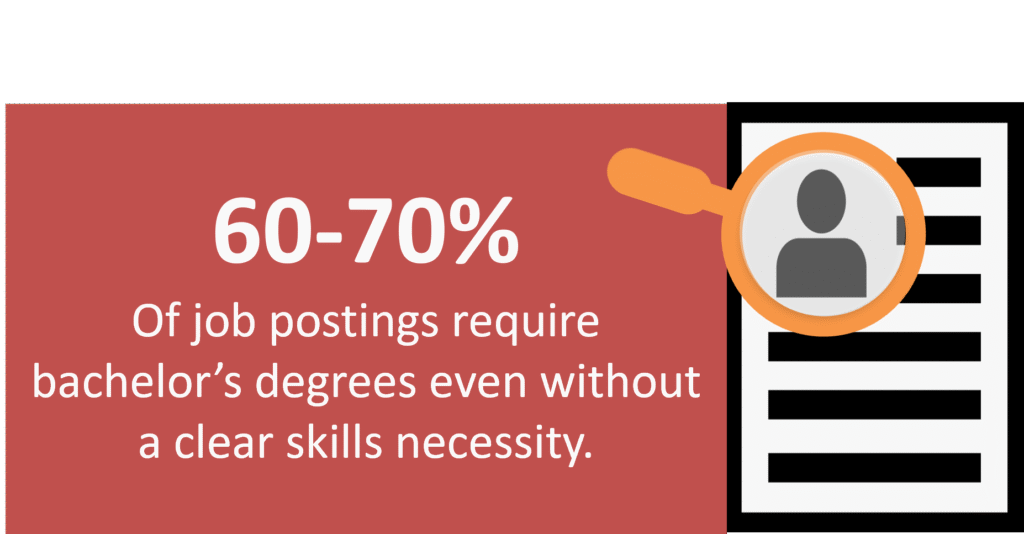
For job-seekers, credentials are slow and expensive to acquire. They require years of time, tuition, foregone wages, and opportunity cost. The burden of signaling is placed almost entirely on individuals, while the benefits of filtering accrue to institutions. This asymmetry is not incidental; it is what makes the signal viable. A signal that were cheap for individuals to acquire would quickly lose its sorting power.
The system, in other words, is optimized for institutional efficiency, not for rapid entry into productive work.
Procedural Risk Reduced, Operational Risk Deferred
Credentials are often described as risk-mitigation tools. In practice, they mitigate one kind of risk far more effectively than another.
They reduce procedural risk: the risk that a hiring decision cannot be defended. A credential provides a socially and legally acceptable rationale for selection. If a hire underperforms, the organization can point to standard requirements and accepted pathways. Responsibility is diffused. The decision remains legitimate even if the outcome disappoints.
What credentials do far less effectively is reduce operational risk: the risk that someone cannot actually perform the work in a reasonable amount of time.
Employers know this. It is why credentialed hires are placed into extended onboarding programs, probationary periods, shadowing arrangements, and internal training pipelines. These practices exist precisely because the credential alone is insufficient to ensure readiness.
This distinction matters because it clarifies why dissatisfaction with credentials rarely leads to structural change. Procedural risk is immediate and visible; operational risk is delayed and distributed. The former is managed upstream. The latter is absorbed downstream.
While this helps explain why credential-based hiring persists, it obscures the cumulative costs created by relying on proxies that do not resolve readiness.
The Costs of Credential-Based Filtering
We can’t ignore the fact that, in effect, organizations pay for certainty twice. First, by outsourcing early-stage filtering to credentialing systems. Second, by absorbing the costs of retraining, supervision, and delayed contribution after hiring. The signal performs its procedural function while leaving the operational problem of readiness largely untouched.
The first payment occurs when organizations rely on credentials to filter candidates upfront:
The second payment occurs after hiring, when readiness must be verified and developed internally:
In practice, the first payment is often assumed to purchase certainty, but delivers little more than administrative reassurance, while the second bears the full cost of making readiness real.
These downstream costs help explain why organizations respond by raising credential thresholds rather than revisiting how readiness is assessed.
Credential Inflation and Declining Signal Power
Over time, this misalignment produces a familiar pattern: credential inflation.
As credentials proliferate, their signaling power erodes. Employers respond by requiring higher levels of credentialing for the same roles, not necessarily because the work has changed, but because the signal has weakened. Workers respond by investing more time and money to remain competitive. The “price” of employability rises even when underlying capability does not.
The result is a growing wedge between nominal value and effective value. A degree still counts, just as it always has – but it buys less readiness per unit than it once did.
This is not an indictment of educational quality. It is a description of how signals behave when they are used beyond their design capacity. Credentials continue to circulate because they remain familiar, standardized, and institutionally sanctioned. Their persistence reflects stability, not optimality.
The danger is not sudden collapse. It is gradual degradation: longer ramps, duplicated training, conservative task assignment, and underutilized talent. Each instance is tolerable. Collectively, they are expensive.
A Necessary Clarification
The failure described here is not a failure of education, nor of how credentials are earned. Education produces long-term benefits – cognitive flexibility, social capital, adaptability – that matter deeply over the course of a career and for society more broadly. Nothing in this argument disputes that value.
The issue is functional, not philosophical.
Credentials are increasingly used as short-term employment signals, particularly as proxies for readiness and speed to contribution. In many roles, they do not reliably perform that function. The mismatch is not about intent; it is about use. A system can remain faithful to its original purpose and still fail to meet the expectations now placed upon it.
The Measurement Gap as Infrastructure Failure
If credentials are misaligned with their current use, why does the system persist?
One answer lies in what is not measured.
Most organizations track hiring volume, time-to-fill, retention, and sometimes performance ratings. Very few explicitly track time-to-competence: how long it takes a new hire to become independently effective under real conditions. Without that metric, delay is experienced as friction rather than diagnosed as cost.
This is a measurement gap, and it is best understood as an infrastructure failure.
Time-to-competence is not a stable or universally comparable metric across roles, firms, or industries. That variability makes centralized measurement difficult. Universities, accreditors, and even many vocational providers are too far removed from real work conditions to assess it meaningfully.
But variability does not argue against measurement. It argues for where measurement must occur.
Measurement must happen closer to the work itself, where context matters and consequences are borne. Employers already absorb the costs of delayed readiness through retraining, supervision, and lost productivity. They therefore have both the incentive and the situational knowledge to assess how quickly new hires become effective.
Decentralized measurement does not mean deregulated or informal. It can be informed by industry standards, regulatory guidance, and shared competency frameworks. What it cannot be is purely abstract. When readiness is treated as unmeasurable, the system defaults to proxies that are easy to apply but poor at revealing delay.
What we do not measure, we cannot mitigate.
Why “Least Bad” Is Still a Problem
Defenders of the status quo often respond that credentials persist because alternatives have failed to scale. Skills-based hiring, work-sample tests, and alternative assessments can increase hiring costs, legal exposure, and operational burden. In that light, credentials remain the least bad option.
This observation is largely correct.
But least bad is still bad. And without measuring the full costs of credential reliance – extended ramp-up time, duplicated training, delayed contribution – the comparison is incomplete. The system remains stable not because it performs well, but because its shortcomings are diffuse, delayed, and rarely evaluated side-by-side with alternatives.
That credentials remain dominant does not mean better approaches do not exist. It means their performance is not yet measured in ways that make comparison possible. In the absence of such evidence, the system defaults to what is most familiar rather than what may be more effective.
A Handoff, Not a Conclusion
Workforce systems rely on credentials as risk filters in ways that no longer align with the outcomes they are expected to produce. The resulting delays are real, costly, and largely invisible because they are not measured where they occur.
If workforce readiness is a shared priority, then learning how readiness actually develops – how long it takes, under what conditions, and at what cost – becomes a necessary next step. That work requires discipline, evidence, and humility. It also requires resisting the comfort of familiar proxies when they obscure more than they reveal.
The most consequential work ahead may not be designing new credentials or hiring systems, but making readiness visible where it actually develops. That work will require employers, educators, and policymakers to examine assumptions that have long gone unmeasured—and to participate in learning how readiness truly forms.
The practical takeaway
Effective learning systems should help people apply knowledge in real contexts, make better decisions, and demonstrate measurable capability over time.
Continue the conversation
Explore related ideas and continue through the Workforce ARC insights series.
About the Author
Patrick Finnegan writes about instructional design, workforce readiness, and capability-based training systems.