
BrightMind / Workforce ARC
Reading mode
What is Role Readiness?
Organizations want stronger performance, more reliable hiring decisions, faster time to capability, and training that translates into real work. At the same time, employees want clearer expectations, fairer evaluation, and better support in reaching readiness and succeeding in their role. All these needs are often handled as separate challenges with separate tools….

April 5, 2026
6 min read
Why This Matters
Organizations want stronger performance, more reliable hiring decisions, faster time to capability, and training that translates into real work.
At the same time, employees want clearer expectations, fairer evaluation, and better support in reaching readiness and succeeding in their role.
All these needs are often handled as separate challenges with separate tools. Hiring is filtered through qualifications, training is measured by completion, assessment is reduced to testing, performance is judged through supervisory interpretation, and career progression is influenced by time served or generalized impressions as much as by demonstrated capability.
All this fragmentation creates a predictable problem.
Organizations end up treating visible signals of preparation as though they were sufficient evidence of readiness, then are disappointed when real work exposes the gap. Employees are expected to perform in systems where expectations are only partly defined, support is uneven, evaluation criteria shift by context, and career movement depends as much on interpretation as on demonstrated capability.
The result is that none of these needs is met – at least not well. What should function as one coherent development system instead becomes a fragmented experience for everyone involved.
This article introduces the central argument of the Role Readiness series: readiness is not something that can be inferred from credentials, course completions, or seat time. It must be defined clearly, developed intentionally, observed credibly, governed consistently, and sustained over time.
Key Takeaways
Signals, Evidence, and Proof
Before going further, it helps to define three terms clearly, because much of the confusion around readiness begins when we treat these as though they mean the same thing.
In business terms, signals are early indicators. They may suggest potential, preparation, or possible fit, but they are often incomplete and open to interpretation. Signals are best used to identify areas for further investigation.
Evidence refers to information, data, or facts used to support a decision. Evidence is more structured and reliable than signals, providing a foundation for analysis and decision-making.
Proof is the point at which the evidence is strong enough, consistent enough, and relevant enough to justify a readiness claim with confidence.
The Problem We Keep Misjudging
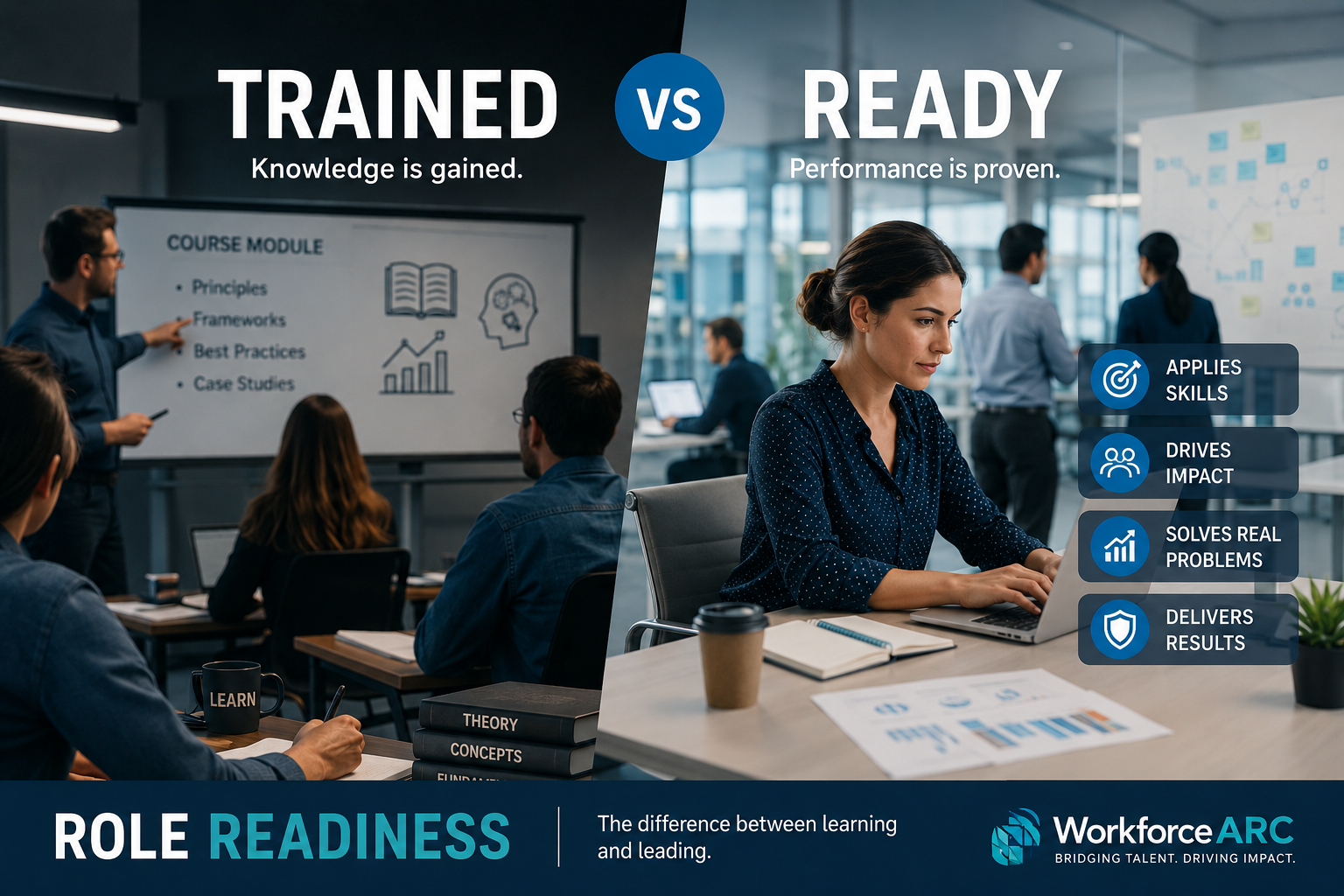
The hiring process is essentially an exercise in risk management, yet many organizations do not treat it with that level of rigor. They use degrees, certifications, badges, résumés, and course completions as signals that while meaningful, do not by themselves prove readiness. These signals may indicate foundational knowledge, persistence, or exposure to a field, but they are often only weak proxies for the work rather than evidence that a person can actually do the work under real conditions.
The same problem shows up inside the organization. A new hire finishes onboarding, completes a sequence of courses, passes an assessment, or receives signoff in a controlled setting. From there, it’s tempting to assume that these signals have established readiness. The trouble is, training environments are usually more structured and more forgiving than live work. The variables are more controlled. The pace is more manageable. The right answer is often easier to identify. Real work is not like that. It includes shifting priorities, incomplete information, live consequences, interpersonal friction, and the pressure of having to perform without ideal support.
The problem is not that qualifications and training are useless, obviously. They are clearly necessary parts of a larger workforce strategy. The problem is that they are frequently treated as though they settle the question. They do not. They may suggest promise. They do not by themselves provide proof of readiness.
When signals are mistaken for evidence, readiness gets conferred too quickly. And when that happens, the organization ends up making stronger claims than its own systems can support.
If readiness is going to mean something operationally, the standard has to be higher than signals alone. That raises the next question: what, exactly, are we trying to define when we talk about readiness in general, and in the context of a specific role?
What Role Readiness Actually Is
At the Workforce Applied Research Center, role readiness is defined as the demonstrated ability to perform the tasks, make the judgments, and sustain the behaviors a role requires under defined support conditions, at the defined standard of acceptability and pace required for successful performance under real work conditions.
That definition matters because it pushes readiness away from vague impressions and toward a more disciplined view of capability. Readiness is not simply a feeling of confidence. Nor is it a résumé category, a generic qualification label, or merely evidence that someone has been exposed to relevant material.
Readiness is a demonstrated state of capability.
That means readiness has to be anchored in actual performance. Not performance in the abstract, but performance under the kinds of conditions the role really imposes. It also means readiness must include more than isolated task completion. In many roles, success depends not only on technical execution, but on communication, prioritization, handoffs, professionalism, escalation, and awareness of how one action affects other parts of the workflow.
This is also why task readiness is not the same as role readiness. A person may be able to complete a procedure and still not be ready for the role.
Why Readiness Is Hard to Define
This work can feel heavy for good reason, but that doesn’t remove the obligation.
Some of the knowledge that matters is hard to see and name clearly. Some of it is poorly documented, documented incorrectly, or not documented at all. Some of it is distributed across multiple people, workflows, and roles rather than sitting neatly inside one job description. In many cases, upstream and downstream processes also shape what readiness really requires, which means the role’s immediate location is not the whole story.
That makes the work of defining role readiness collaborative and logistically demanding. Subject matter experts, supervisors, and process owners often have to contribute. The role has to be understood not only in isolation, but in context.
Defining readiness requires context.
But difficulty is not a reason to avoid the work. Organizations already pay for weak readiness at multiple levels:
A Clear Way to Define Readiness Within a Role
If we are going to define readiness within a role clearly, we need to answer three basic questions:
That structure should feel familiar to instructional designers because it follows the logic of a strong performance statement – task, conditions, and standards. This formula is not meant to reduce readiness to something simplistic. It is meant to create a disciplined framework for describing what the role actually requires.
This framework can be visualized as follows:
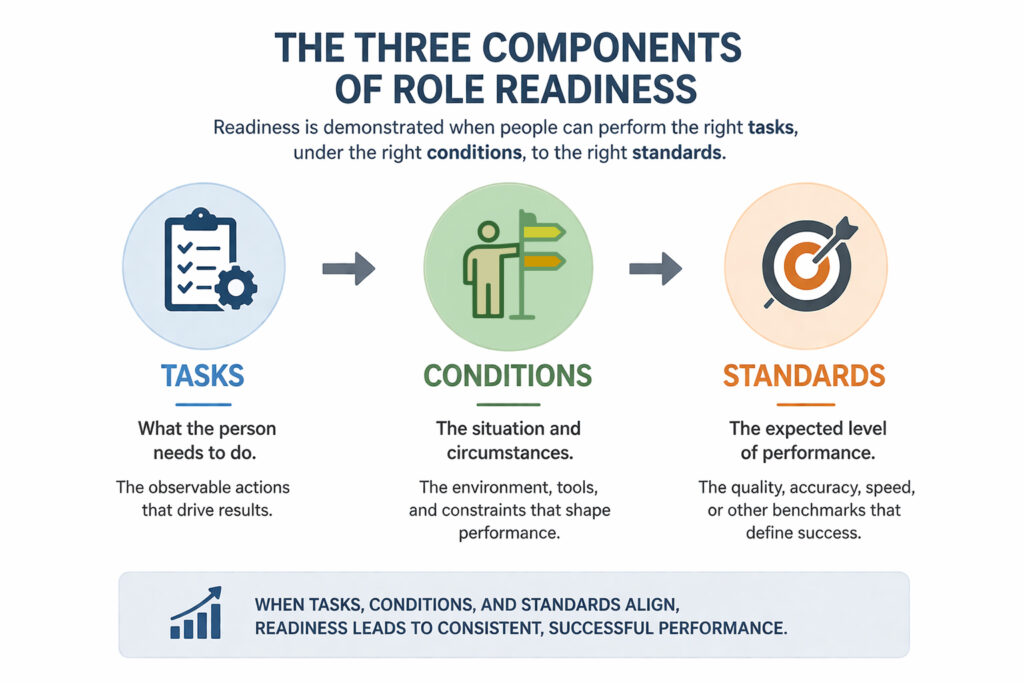
Taken together, these three questions move the discussion from broad labels to operational clarity. They also expose why so many readiness discussions remain shallow. It is far easier to name a credential than to define the actual demands of performance.
Readiness as Blueprint and Benchmark
A strong readiness definition should do more than describe the role. It should function as both blueprint and benchmark.
As a blueprint, it gives onboarding, training, guided practice, and support a clear target. As a benchmark, it gives the organization a more legitimate basis for assessment, observation, and evaluation. The same definition that shapes development should also shape the judgment of whether readiness is actually present and sustainable.
As a blueprint
Defines how people are trained and supported to reach readiness.
As a benchmark
Defines how readiness is evaluated and confirmed in real performance.
That alignment matters. If readiness is used only as a blueprint, training may create familiarity without evidence. If it is used only as a benchmark, people may be judged by expectations they were never clearly taught, practiced, or scaffolded toward.
Used in both ways, the definition creates stronger continuity across the full development ecosystem. It helps the organization build toward readiness, judge performance against the right criteria, and interpret shortfalls with greater clarity. When someone falls short, the issue may be in task execution, judgment, pace, consistency, documentation, or level of support still required. But the shortfall may also reveal that the readiness definition itself was underdefined, miscalibrated, or incomplete.
In that sense, a strong readiness definition does more than describe the role. It helps diagnose shortfalls and shape development.
Why This Becomes a System Question
Once readiness is defined clearly enough to matter, a larger issue comes into view.
If readiness is the demonstrated ability to perform under real conditions and standards, then it cannot be treated as a one-time checkpoint or a vague byproduct of training. It becomes something that must be developed intentionally, observed credibly, governed consistently, and sustained over time. When readiness is defined well, it becomes more than a training target. The same criteria can inform hiring, onboarding, training, best practice, observation, evaluation, advancement, and succession planning, giving the organization a more consistent view of what capable performance actually requires.
This is where organizations often fragment. They define success one way in training, assess it another way in a controlled environment, coach it a third way on the job, and review it through still another set of expectations in performance management and career progression. When that happens, employees end up having to decode the system instead of simply learning the role.
A stronger model treats role readiness as a connected architecture. The same performance logic that defines readiness should shape development. It should influence what is observed, how support is delivered after training, how performance is judged once work becomes live, and how advancement decisions are made.
A Foundation for the Rest of the Series
This series begins from a simple premise: role readiness should not be inferred from proxies when it can be defined, built, and judged more clearly.
The first task is to stop confusing qualifications, training, and readiness. The second is to define readiness more rigorously. But that’s not the end of the work. Once readiness is clarified, the harder questions begin.
Those are the questions the rest of the series will take up.
Conclusion
Organizations will continue hiring, onboarding, training, assessing, and evaluating people whether readiness has been clearly defined or not. That much is unavoidable. What remains within our control is the standard by which those decisions are made.
That is why role readiness matters. It gives shape to a distinction many organizations already feel but have never adequately defined. Qualifications and training may matter, but neither one settles the question. Readiness has to be understood in relation to real work, real conditions, and real standards.
Defining readiness requires context.
Once that becomes clear, the opportunity becomes clearer as well. A stronger definition of readiness gives the organization something firmer to build toward and something sounder to judge against. It gives employees clearer expectations and creates a more legitimate basis for support and evaluation. It also provides an opportunity to create a talent development system that is more coherent than the fragmented one so many organizations are currently trying to manage.
That is the promise behind the rest of this series. The work does not end with defining readiness more clearly. It continues in how readiness is developed, how it is observed and measured, how it is governed, and how it is sustained once real work begins.
The practical takeaway
Effective learning systems should help people apply knowledge in real contexts, make better decisions, and demonstrate measurable capability over time.
Continue the conversation
Explore related ideas and continue through the Workforce ARC insights series.
About the Author
Patrick Finnegan writes about instructional design, workforce readiness, and capability-based training systems.